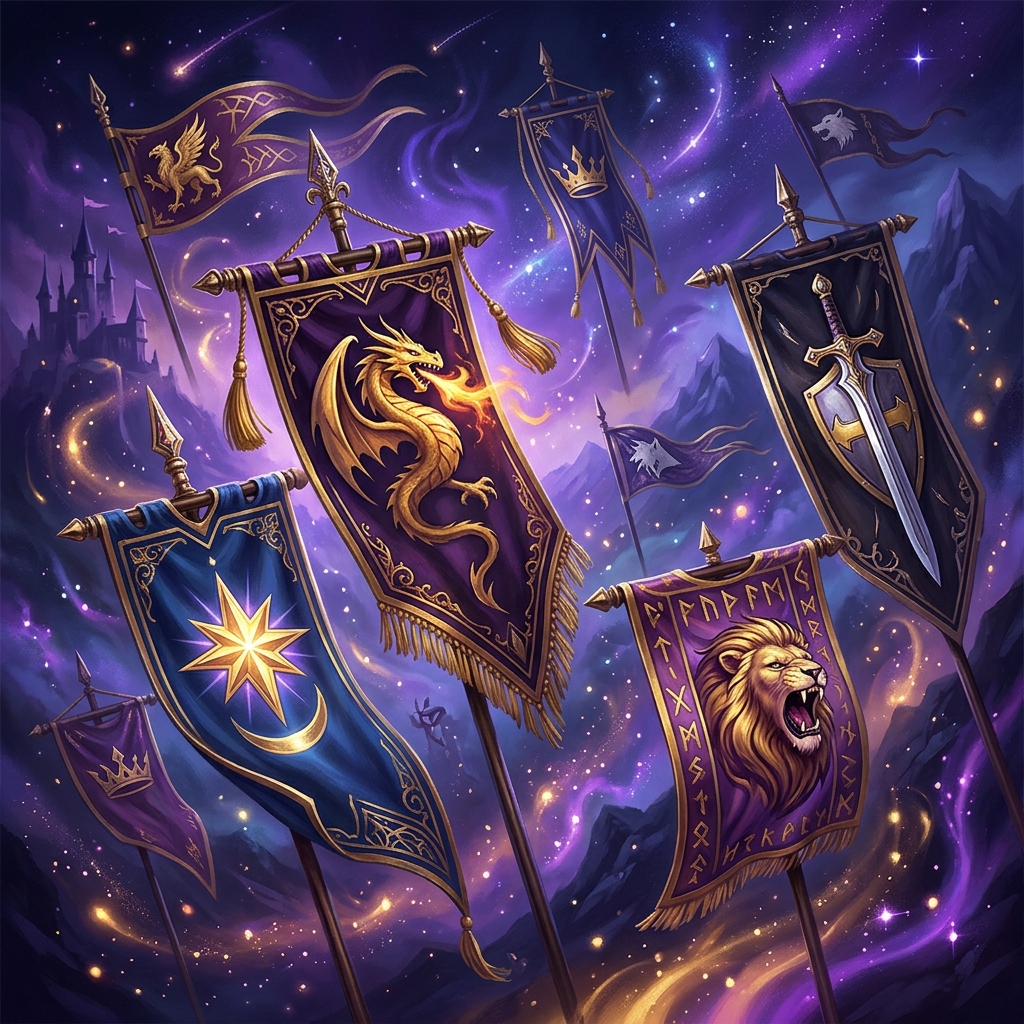
Fantasy Faction Flags: Design Guide for Worldbuilders
Why faction flags matter in worldbuilding
In Tolkien's Middle-earth, Gondor's banner — a white tree on black — appears at every pivotal moment of the War of the Ring. In George R.R. Martin's Westeros, house sigils (essentially simplified flag charges) carry as much narrative weight as character dialogue. In D&D campaigns, the banners of rival factions are some of the first things players recognize and remember.
A well-designed faction flag is not decoration. It's a piece of exposition that communicates history, values, and allegiance before a single word is spoken. This guide shows you how to design one.
The four questions a faction flag must answer
Before touching any design tool, answer these four questions about your faction. The answers will determine every visual choice.
1. What does the faction value above all else?
- Power → bold primary colors, aggressive symbols (sword, eagle, closed fist)
- Knowledge → cool colors (blue, purple), symbols of observation (eye, star, book)
- Nature → greens and earth tones, organic symbols (tree, animal, leaf)
- Commerce → gold and red, symbols of exchange (scales, ship, coin)
- Faith → deep colors, religious symbols specific to your world's faith system
2. What is the faction's history?
- Founded in war → battle symbols, swords, shields, crossed weapons
- Founded as a guild or trade order → tools of the trade as the primary symbol
- Founded by a legendary figure → a symbol associated with that person
- Ancient vs new → older factions use more heraldic styles; newer ones can be more graphic
3. Who are the faction's enemies?
- Contrasting colors with enemy factions creates immediate visual drama. If the noble house of the North uses white and blue (ice, cold, purity), the rival house of the South should use red and black (fire, warmth, aggression). Color becomes allegory.
4. What does the faction want viewers to feel?
- Fear: dark background, aggressive symbols, sharp shapes
- Trust: calm colors (blue, green), stable symbols (tree, anchor, shield)
- Reverence: deep colors, religious or celestial symbols
- Inspiration: bright colors, upward-pointing symbols (star, sun, rising bird)
The heraldic system: why it works for fantasy factions
Medieval European heraldry developed a sophisticated visual language for exactly this purpose — identifying armed groups at distance. Modern fantasy worldbuilders can steal the entire system.
Tinctures (the heraldic color palette)
Heraldry uses seven standard colors. Sticking to these creates visual coherence within a fantasy world's flag system.
| Tincture | Modern color | What it communicates | |---|---|---| | Or | Gold / yellow | Wealth, generosity, leadership | | Argent | Silver / white | Purity, peace, neutrality | | Gules | Red | Courage, sacrifice, military heritage | | Azure | Blue | Loyalty, truth, calm authority | | Sable | Black | Strength, grief, mystery | | Vert | Green | Hope, nature, growth | | Purpure | Purple | Royalty, ambition (rare — use sparingly) |
The rule of tincture (critical for legibility): never place a color on another color, and never place a metal (Or/Argent) on another metal. Always separate:
- Color on metal (e.g., red symbol on gold background) ✓
- Metal on color (e.g., gold symbol on black background) ✓
- Color on color (e.g., red symbol on blue background) ✗ — illegible at distance
Charges (the symbols on the shield)
Classic heraldic charges and what they communicate in a fantasy context:
| Charge | Fantasy interpretation | |---|---| | Lion (rampant) | Noble house, great strength, monarchy | | Eagle (displayed) | Empire, aerial power, far-sight | | Dragon | Raw power, hoarded knowledge, ancient origin | | Serpent | Cunning, transformation, poison-users | | Wolf | Pack loyalty, wilderness, hunting | | Stag | Nature, nobility, forest connection | | Raven | Death omens, dark knowledge, messengers | | Phoenix | Rebirth, fire magic, survival | | Sword | Military faction, warrior order | | Shield | Defensive order, guardians, protection | | Scales | Merchant guild, law, judgment | | Crossed keys | Religious organization, gatekeepers, secrets | | Tower | Fortress, stasis, immovability | | Ship | Maritime faction, trade routes, exploration | | Lantern | Illumination, knowledge, guidance through darkness | | Skull | Undead faction, death cult, pirate company |
Five faction types with worked design examples
Faction Type 1: The Noble House
Scenario: House Vaelthorn — an ancient northern noble family whose ancestral lands border a magical forest. They are proud, cold, and secretive.
Design decisions:
- Colors: Deep blue (Azure) and silver (Argent) — cold tones for northern climate
- Symbol: A silver stag on blue — noble, forest-connected
- Background: No stripes or crosses — a solid field signals ancient, unified power
- Shape consideration: Wide horizontal proportions (3:2) — suggests stability, not aggression
What to avoid:
- Too many symbols (one charge is enough for a noble house)
- Bright or warm colors (contradicts the cold northern concept)
- Thin or complicated stag silhouette (must read at banner scale, where detail collapses)
In FlagCreators editor: Solid blue field, centered silver stag from the symbol library, 3:2 ratio.
Faction Type 2: The Mercenary Company
Scenario: The Iron Fang — a mercenary company with no national allegiance, operating across multiple kingdoms. Feared for efficiency, not ideology.
Design decisions:
- Colors: Black (Sable) and gold (Or) — maximum contrast, reads as threatening and wealthy
- Symbol: A closed iron fist — power, control, non-religious
- Background: Diagonal black and gold stripes — dynamic, suggests movement and aggression
- Ratio: 1:2 — longer flags move dramatically in wind (mercenaries care about visual impact in the field)
Additional detail:
- The fist should be centered on the diagonal junction — where the eye naturally falls
- The fist's silhouette should be simplified enough to be reproduced on shields and armor
What to avoid:
- Red (implies national allegiance or blood — mercenaries want neutrality)
- Complex imagery (mercenaries need something that reproduces quickly on equipment)
Faction Type 3: The Mage's Guild
Scenario: The Argent Circle — a society of arcane researchers, politically neutral, wealthy from selling services to all sides.
Design decisions:
- Colors: Deep purple (Purpure) and silver (Argent) — purple for arcane ambition; silver for neutrality and payment
- Symbol: An eight-pointed star (compass rose variant) — eight directions of knowledge, no single orientation
- Background: Solid purple field with the star large enough to fill 40% of the flag height
- Internal note: A circle within the star (the "circle" of the faction name) creates a secondary layer visible at close range
What to avoid:
- Red or black (too aggressive — the guild is neutral, not threatening)
- Crossed swords or weapons (the guild is not a military body)
- A wand or book (too literal — the star is more universal)
Faction Type 4: The Pirate Republic
Scenario: The Free Fleet — a loose federation of pirate ships operating from a hidden island base. Ideology: freedom from any authority, mutual aid between members.
Design decisions:
- Colors: Red (Gules) and black (Sable) — maximum aggression and terror; traditional pirate palette
- Symbol: A skull with crossed swords (Jolly Roger evolution) — but the skull has an open crown on top (they crown no one but themselves)
- Background: Black field — darkness, the night in which they operate
- Ratio: 2:3 standard but flown vertically during ceremonies (meaning changes with orientation — a maritime tradition)
The crowned-skull variation: Rather than a plain skull, the crowned skull communicates: "We answer to no king." This is specific storytelling, not generic pirate imagery.
Faction Type 5: The Forest Resistance
Scenario: The Thornwood Pact — a decentralized resistance of forest-dwellers fighting against a northern empire's expansion. No central leader, no fixed base.
Design decisions:
- Colors: Green (Vert) and brown/Or — nature's palette; no metals or royal colors (they reject monarchy)
- Symbol: A bare tree (branches visible, no leaves) — resilience through winter, stripped-back nature, waiting to bloom
- Background: Diagonal split — green upper half (the canopy), gold lower half (the root/earth). The tree spans both halves
- Ratio: 1:1 square — unusual and memorable; squares feel stable and immovable (like a tree)
Storytelling element: The bare tree is intentional — a full-leaf tree would suggest thriving. The Thornwood Pact is fighting, not thriving. The bare branches communicate sacrifice and struggle, not defeat.
Building a consistent flag system for multiple factions
If your world has multiple factions, their flags should form a visual system:
1. Give each faction a primary color that's unique to them Assign colors first, at the world level. If House Vaelthorn owns Azure (deep blue), no other northern house should use the same shade. Overlap is fine for distant factions; it causes confusion for rivals who appear in the same scenes.
2. Use the same proportions for factions of the same type
- Noble houses: 3:2
- Military companies: 1:2 (long)
- Religious organizations: 2:3 or square
- Guilds: 2:3
Consistent ratios within a type help readers identify the type before identifying the specific faction.
3. Establish a symbol grammar
- Crowns appear only on royal factions
- Stars appear only on magical/knowledge factions
- Animals are for ancient families
- Weapons are for military factions
- Objects (scales, keys, ship) are for guilds
When a faction breaks the grammar (a merchant guild using a lion), it becomes a plot point.
FAQ
Can my fantasy faction use real heraldic rules? Yes, and it's strongly recommended. Heraldic rules (especially the rule of tincture) exist because they solve real legibility problems. A flag that's illegible at distance fails its purpose in your fiction as much as in reality.
Should every faction in my world have a flag? Not necessarily. Flags belong to organized factions with territory or ships. A roving band of outlaws probably doesn't have a formal flag — they might have a symbol painted on shields. The presence or absence of a flag communicates organizational structure.
How do I make my flags feel original but not random? The system above (four questions → color assignment → symbol from heraldic grammar) produces original results because the inputs are your world's specific context. Two worldbuilders using the same system produce completely different flags.
What's the most common mistake in fantasy flag design? Using too many elements. A coat of arms (multiple symbols, borders, supporters) belongs on a seal, not a flag. One primary symbol, clearly readable as a silhouette at 50 metres, is a flag.
Design your faction flags: → Fictional Flag Maker | → AI Flag Generator | → Flag Editor
Related reading: How to Make a Fake Country Flag | Kingdom and Empire Names
Ready to apply these concepts?
Start designing your own custom flag using our free AI-powered canvas editor.