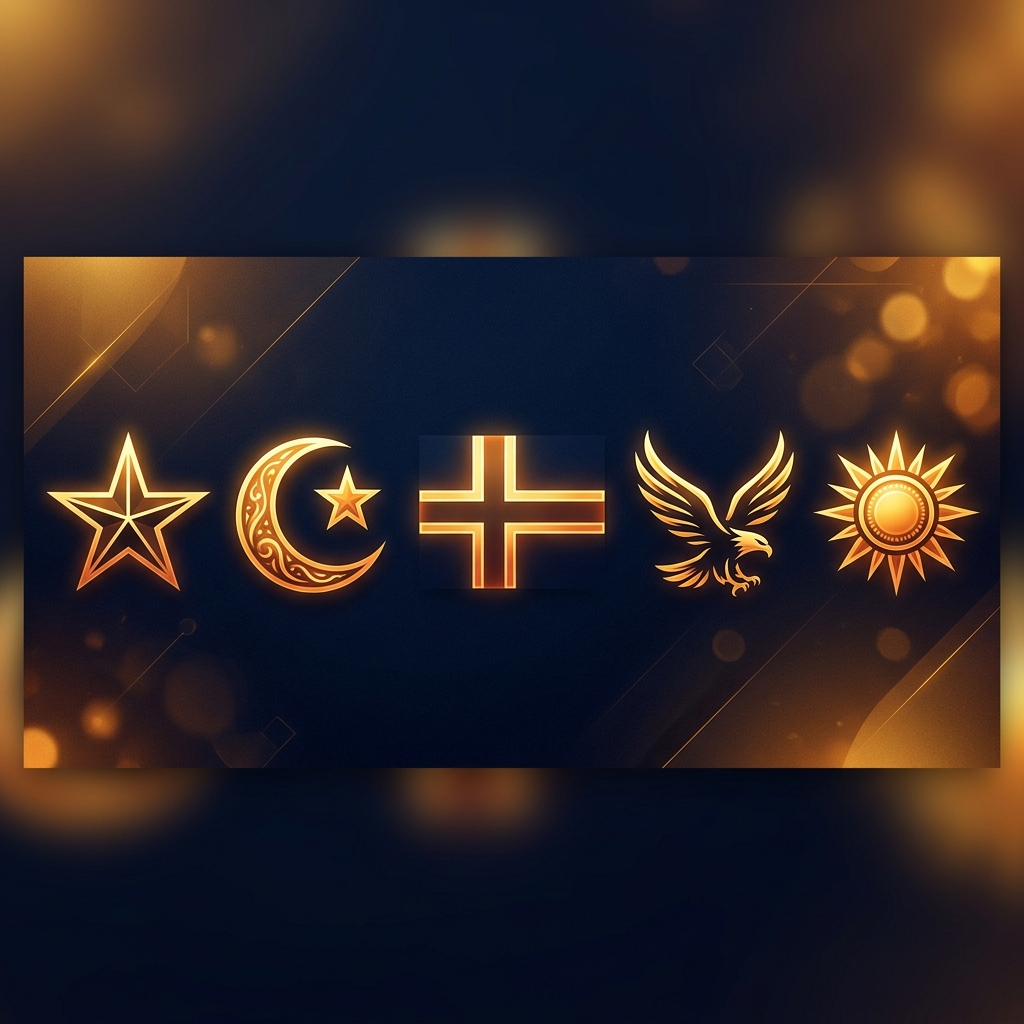
Flag Symbols and What They Mean | Vexillology
Flags are a visual language — symbols are the vocabulary
Every element on a flag was chosen deliberately. A star does not appear by accident; a crescent does not land in a specific quadrant at random. Each symbol carries a documented meaning — sometimes centuries old, sometimes adopted as recently as independence — and understanding those meanings is the foundation of reading a flag correctly.
This guide covers the ten most common flag symbols, what they represent across different cultures, and how to use them effectively in your own flag design.
Ready to add a symbol to your flag? → Open the Flag Editor or → Generate with AI.
Stars
Stars are the single most common symbol on national flags — over 60 countries use at least one.
What stars represent
- Guidance and aspiration — pointing toward a goal, a future, a north
- Individual states or regions — each star in the US flag represents one state; the 12 stars in the EU flag represent unity (not a specific number of members)
- Ideological unity — the single five-pointed star appears on the flags of China, Cuba, Morocco, and Vietnam as a symbol of socialist unity
- Liberation and independence — newly independent nations frequently add a star to mark the moment of self-determination
Star types and their meanings
| Star type | What it signals | Example flags | |---|---|---| | Five-pointed (pentagram) | Most universal; unity, guidance | USA, China, Cuba, Morocco, Senegal | | Six-pointed (Star of David) | Jewish identity, Israel's founding | Israel | | Seven-pointed | Federation (each point = one state/territory) | Australia, Jordan | | Eight-pointed | Islamic heritage; also used in heraldry | Azerbaijan, Kazakhstan | | Multi-star cluster | Multiple states or islands grouped | Southern Cross (Australia, Brazil, New Zealand) |
Design tip
A single star has more impact than five. Stars work best as focal points, not as pattern elements. If you use multiple stars, align them or group them intentionally — scattered stars read as decoration, not meaning.
Crescents
The crescent moon is one of the oldest and most recognizable symbols in flag design, found on the flags of Turkey, Pakistan, Tunisia, Algeria, Mauritania, and many others.
What crescents represent
- Islamic faith — the crescent was used by the Ottoman Empire and is now associated worldwide with Islam, though it pre-dates Islam and does not appear in the Quran as a religious symbol
- Lunar calendars — cultures that used lunar calendars used the crescent as a time marker
- New beginnings — the waxing crescent specifically represents growth and new starts
Crescent orientation
- A crescent facing right (opening left) is the most common in flags; it aligns with the moon rising in the east
- A crescent paired with a star (Pakistan, Turkey, Tunisia) — the star sits inside or beside the crescent opening; placing the star outside the crescent is a common error in amateur designs
Design tip
A crescent needs to be large enough to read at distance. At small sizes, the curved gap that defines it as a crescent collapses into a circle. Use a 20–25% flag-width minimum for the crescent's outer diameter.
Crosses
The cross is the dominant symbol of Christian-heritage nations and the defining element of the Nordic cross family.
Cross types and their flag meanings
Latin cross (vertical bar longer than horizontal)
- Christian faith, often combined with national colors to distinguish
- England (red on white), Georgia (red on white with four smaller crosses), Switzerland (white on red)
Nordic cross (horizontal bar shifted toward the hoist)
- Represents the cross but also emphasizes the hoist — the direction the flag flies from
- Denmark, Sweden, Norway, Finland, Iceland all use this format
- The off-center position is deliberate: when the flag hangs still, the longer fly side balances the visual weight
Saltire / Saint Andrew's Cross (diagonal cross)
- Scotland (white on blue), Jamaica (yellow on black and green), Burundi
- The diagonal cross avoids confusion with the vertical cross and creates a more dynamic composition
Greek cross (equal arms)
- Switzerland (white on red), Red Cross symbol, Georgia
- Works best as a centered emblem rather than a field pattern
Design tip
A cross that reaches edge to edge is stronger than one that floats. Nordic countries anchor their crosses at the hoist — study how the cross proportions relate to the flag's width before placing yours.
Eagles
Eagles appear on more flags and coat of arms than any other animal — Germany, the United States, Mexico, Poland, Russia, Albania, Egypt, and many others.
What eagles represent
- Power and authority — the eagle was the emblem of the Roman Empire; successor states adopted it to claim continuity
- Freedom — the bald eagle represents freedom in the US; the golden eagle represents the same in Mexico (though Mexico's eagle also references an Aztec myth)
- Double-headed eagle — the two-headed eagle (facing both left and right simultaneously) represents ruling two directions: East and West. Used historically by the Byzantine Empire, later by Russia, Serbia, Albania, and Montenegro
Eagle styles
| Style | Feeling | Example | |---|---|---| | Spread-wing (displayed) | Power, declaration | Germany, USA (seal) | | Profile (passant) | Movement, forward progress | Mexico (with serpent) | | Double-headed | Duality, empire | Albania, Montenegro | | Simplified / geometric | Modern, bold | Many post-independence flags |
Design tip
Eagles are complex symbols. In small formats, the details collapse. Either simplify to a geometric silhouette or keep the eagle as a large central element occupying 30–40% of the flag's area.
Suns
The sun is the universal symbol — it appears across every culture, on every continent, with consistent meaning.
What suns represent
- Life and energy — the sun sustains all life; it's the earliest and most cross-cultural of all symbols
- National identity — Argentina's "Sun of May" commemorates the May Revolution of 1810; Uruguay uses the same sun
- Buddhism and Hinduism — the rising sun in Japan's flag (Hinomaru) represents the nation's position at the eastern edge of the world; it has no religious meaning in the official flag
- Independence — new nations frequently add a sun to express a new dawn
Sun styles
Rayed sun (with beams) The most common sun in flags. The number of rays is often significant: Argentina's Sun of May has 32 alternating straight and wavy rays; the Macedonian sun has 8 extended rays.
Rising sun (half-disc) Japan (Hinomaru uses a full disc, but Japan's naval jack uses rising sun rays), Bangladesh (red disc on green).
Simple disc Japan, Bangladesh, Palau (yellow on blue). The disc is the most legible sun format at any size.
Design tip
Rays are decorative unless they carry symbolic weight. If you use a rayed sun, be consistent: count your rays and decide if the number means something.
Lions
Lions appear on the flags and coat of arms of England, Scotland, Sri Lanka, Ethiopia, Morocco, Bhutan (as a dragon, the Asian lion equivalent), and dozens of former British territories.
What lions represent
- Monarchy and nobility — the lion is the "king of beasts"; its use signals royal authority
- Courage — the lion is the most common heraldic animal precisely because it communicates strength without aggression
- National pride and continuity — England's three golden lions on red have been used for 800+ years; their continued use signals historical depth
Lion postures (from heraldry)
| Posture | Name | Meaning | |---|---|---| | Standing on three legs, one raised | Passant guardant | Most common; alert but not attacking | | Standing upright on two legs | Rampant | Most aggressive; fighting posture | | Seated, facing viewer | Sejant | Authority, judgment |
Design tip
Lions work at large scale. Avoid placing them at less than 25% of flag height — at that size, the mane disappears and it reads as an unidentifiable quadruped.
Trees and Plants
Trees and plants are less common than geometric symbols but carry powerful localized meaning.
What trees represent
- Cedar of Lebanon — Lebanon's flag: the cedar is both the nation's most famous tree and a biblical symbol of strength and eternity
- Olive branches — Cyprus: the olive branch represents peace between the island's Greek and Turkish communities (though it remains aspirational)
- Baobab — proposed in several African redesigns: the baobab is "the tree of life" in Sahelian Africa
- Sugar maple leaf — Canada: the maple leaf replaced the Union Jack in 1965; chosen because the maple tree is uniquely Canadian and the leaf is instantly recognizable
Design tip
Plant symbols work best as silhouettes. The Canada maple leaf is powerful because it's one of the most recognizable leaf shapes in the world. If your plant isn't instantly recognizable as a silhouette, abstract it further until it is.
Swords
Swords appear on the flags of Saudi Arabia, Oman, Brunei, and the coat of arms of many former kingdoms.
What swords represent
- Military strength — the sword is the oldest human-made symbol of force
- Justice — in heraldry, the sword often appears with scales, representing the balance of force and law
- Islamic heritage — the Saudi flag's sword (combined with the Shahada inscription) represents both the authority of the Islamic faith and the House of Saud's military defense of it
Design tip
Swords are directional — they point somewhere. Orient the blade intentionally: pointing toward the hoist (the pole) signals defense; pointing toward the fly signals aggression or expansion. Most Islamic flags point the sword upward.
Horizontal bars and stripes
Stripes are not traditionally considered "symbols," but horizontal bars carry specific meaning in their layout.
What stripe arrangements represent
- Tricolors (three equal horizontal stripes) — originally associated with the French Revolution and Republican government; spread globally from the 1790s onward
- More than three stripes — often represent geographic features (land, sky, sea) or different groups within a nation (Sierra Leone's blue represents Freetown harbour)
- Unequal stripe widths — heavier stripes signal priority; Thailand's central blue stripe is double-width, giving Buddhism (the blue) greater visual weight
The Nordic cross revisited: a symbol within a symbol
The Nordic cross is worth separate treatment because it is simultaneously a symbol (the Christian cross) and a layout principle.
The cross reaching edge to edge on all four sides divides a flag into four quadrants. The proportions of those quadrants — which are square (hoist side) versus rectangular (fly side) — is determined by the cross width relative to the flag's height.
Standard Nordic cross proportions (used by the five Nordic countries):
- Cross width = 2/9 of flag height
- Horizontal cross center = 2/5 from hoist edge
- This creates a 2:3 flag divided into rectangles of ratio approximately 2:3 on the left and 3:5 on the right
No other flag layout has been as precisely codified. If you use a Nordic cross, follow these proportions — they are what make the flag read as Scandinavian rather than arbitrary.
Symbol table: 30+ symbols with documented meanings
| Symbol | Typical meaning | Example flag | |---|---|---| | Five-pointed star | Unity, guidance, independence | Senegal, Cuba, Vietnam | | Six-pointed star | Jewish identity, protection | Israel | | Seven-pointed star | Federation of states/territories | Australia, Jordan | | Southern Cross | Southern hemisphere, navigation | Brazil, New Zealand, PNG | | Crescent | Islam, lunar calendar, new start | Turkey, Pakistan, Tunisia | | Latin cross | Christianity | Switzerland, Georgia | | Nordic/Scandinavian cross | Nordic heritage, Christianity | Denmark, Norway, Iceland | | Saltire (diagonal cross) | St Andrew (Scotland), diagonal heritage | Scotland, Jamaica | | Eagle (spread wing) | Imperial power, freedom | Germany, USA | | Eagle (double-headed) | East-West duality, empire | Albania, Serbia | | Eagle + serpent | Aztec founding myth | Mexico | | Lion (rampant) | Royalty, courage | England, Scotland | | Lion (passant) | Authority, vigilance | Sri Lanka | | Dragon | Eastern power, protection | Bhutan | | Sun (disc) | Life, national identity | Japan, Bangladesh | | Sun (rayed) | New dawn, revolution | Argentina, Uruguay | | Rising sun | Eastern identity, dawn | Japan (naval) | | Cedar tree | Strength, eternity | Lebanon | | Maple leaf | National identity, nature | Canada | | Olive branch | Peace, reconciliation | Cyprus | | Sword (upward) | Military defense, justice | Saudi Arabia | | Shahada script | Islamic faith declaration | Saudi Arabia | | Scales | Justice, law | No major flag; rare | | Wheel (Ashoka Chakra) | Progress, dharma, Buddhist law | India | | Trident | Naval power, seafaring identity | Barbados | | Fasces / sheaf | Unity of the many as one | Historical; avoid today | | Hand | Sovereignty, ownership of land | Historical Ulster | | Ship | Maritime heritage | — | | Wheat / grain | Agriculture, abundance | — | | Mountain | Geography, resilience | — | | Key | Gateway, access, custodianship | Gibraltar | | Castle | Defense, fortification | Spain, Gibraltar | | Anchor | Maritime heritage, hope | — |
FAQ
Do I have to use a historically documented symbol? No. For a fictional or personal flag, you can invent symbols. What matters is that the symbol is legible as a silhouette at distance, meaningful to the flag's creator, and not so complex that it collapses at small sizes.
Can I use religious symbols on a non-religious flag? Yes, but be deliberate. A cross on a non-Christian flag will be read as Christian. If your intent is cultural or historical (not religious), use simplified or abstracted versions and acknowledge the distinction in the flag's documentation.
What's the most overused flag symbol? The five-pointed star. If you want distinctiveness, consider replacing it with a seven-pointed star (rare outside Australia and Jordan), an eight-pointed star, or a geometric shape that has personal meaning to your design's context.
How many symbols is too many? One is ideal. Two is the practical maximum for legibility at distance. Three or more symbols produce a seal or coat of arms, not a flag. The world's most recognizable flags — Japan, Canada, Switzerland — use one symbol each.
Colors carry meaning alongside symbols — learn how to pair them in Flag Color Combinations and Flag Colors and Their Meanings.
Design your flag now: → Flag Editor | → AI Flag Generator | → Random Flag Generator
Ready to apply these concepts?
Start designing your own custom flag using our free AI-powered canvas editor.