How to Make a Coat of Arms | Heraldry Guide
What a coat of arms actually is (and what it isn't)
A coat of arms is a heraldic design originally used to identify a knight on the battlefield — full armor made faces unrecognizable, so symbols on the shield did the job instead. The term comes from the surcoat (a cloth garment) worn over armor, which bore the same design.
A coat of arms is not the same as:
- A flag (a coat of arms belongs to an individual or family; a flag belongs to a territory or organization)
- A family crest (the crest is just one part of a full achievement — the element above the helmet; people use "crest" incorrectly to mean the whole design)
- A logo (logos are commercial marks; a coat of arms is a heraldic achievement with regulated structure)
Today, coats of arms are used by individuals, families, universities, cities, corporations, and fictional entities in games and books. This guide teaches you how to design one correctly.
The parts of a coat of arms
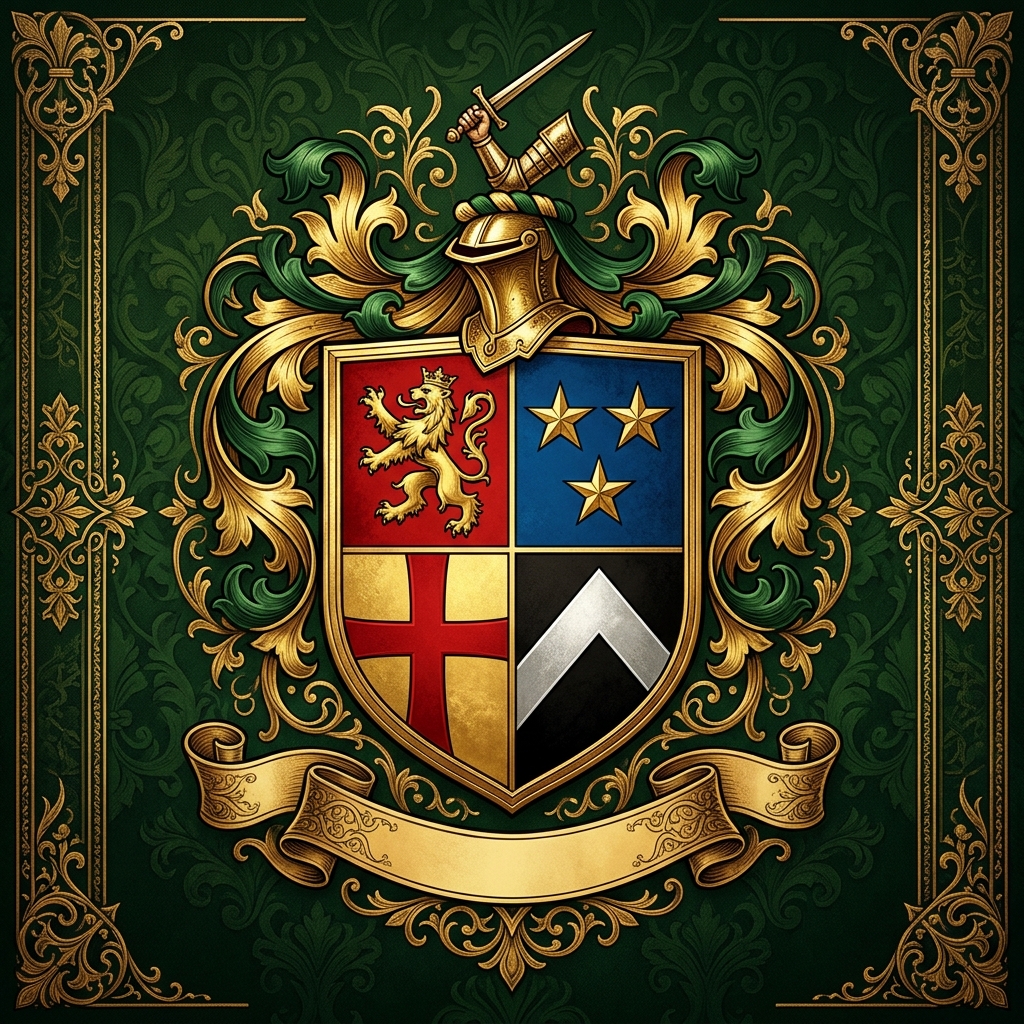
A full heraldic "achievement" can have up to seven components. You don't need all of them — the shield alone is the minimum.
1. Shield (escutcheon) — required
The central element. Everything else frames it. The shield's design — tinctures and charges — is what people mean when they say "coat of arms."
2. Helm (helmet) — optional
Sits on top of the shield. The style of helm historically indicated rank:
- Full-face helm: royalty
- Tilting helm (barred visor): knights and gentlemen
- Open-faced helm: nobility
- Steel helm (no decoration): simple gentry
3. Crest — optional
The three-dimensional element that sits on top of the helm, usually an animal, plant, or object. The crest is often confused with the whole coat of arms.
4. Mantling — optional
Decorative cloth (originally a real cloth cover for the helm to deflect sun) hanging from the helm on both sides. Usually the primary color lined with the primary metal of the shield.
5. Supporters — optional, rare
Figures (animals or humans) that stand on either side and appear to hold up the shield. Supporters are traditionally reserved for peers of the realm, corporations, and nations. For personal/fictional coats of arms, omit unless you have a good creative reason.
6. Compartment — optional
The ground on which the supporters stand. Often grass, water, or a decorative base.
7. Motto — optional
A phrase below the shield (or in Scottish tradition, above the crest). The motto should be short, in any language, and preferably not in English (Latin, French, Scottish Gaelic, or an invented language for fictional arms).
The shield: designing your escutcheon
The shield is where all the creative decisions happen. Three rules govern its design.
Rule 1: The rule of tincture
This is the most important rule in heraldry. It governs every coat of arms ever granted.
The rule: Never place a color on a color, and never place a metal on a metal.
The heraldic palette divides into two families:
- Metals: Or (gold/yellow) and Argent (silver/white)
- Colors: Gules (red), Azure (blue), Sable (black), Vert (green), Purpure (purple)
A symbol (charge) must contrast with its background. If the background is a color (red, blue, etc.), the charge must be a metal (gold or white). If the background is a metal, the charge must be a color.
Examples:
- White lion on red background: ✓ metal (Argent) on color (Gules)
- Gold eagle on blue background: ✓ metal (Or) on color (Azure)
- Red cross on blue background: ✗ color (Gules) on color (Azure) — illegible
- White star on gold background: ✗ metal (Argent) on metal (Or) — illegible
The rule exists because these designs need to be read at distance and reproduced in embroidery, painting, and stone carving. Breaking it produces muddy, unreadable results.
Rule 2: Keep it simple enough to describe in words
Every coat of arms has a verbal description called a blazon. The blazon uses precise heraldic language to describe the shield so completely that any herald anywhere in the world can reproduce the design without ever seeing the original.
If your design can't be described in two sentences, it's too complex.
Example blazon: "Azure, a fess Or between three fleurs-de-lis Argent" = blue field, horizontal gold bar, three white fleur-de-lis (two above the bar, one below).
Rule 3: Charges must be recognizable as silhouettes
A coat of arms must work on:
- An embroidered surcoat (low resolution)
- A carved stone (no color)
- A wax seal (small scale)
- A painted shield (no outline detail)
If your symbol requires fine detail to be understood, simplify it. A lion that's a bold silhouette is a better heraldic charge than a realistic lion portrait.
Heraldic shield shapes
The shape of the shield is a design choice. Historically, shield shapes evolved with armor styles:
| Shape | Name | Best for | |---|---|---| | Classic heater (pointed bottom) | Heater shield | Medieval European arms; most traditional | | Round bottom (lozenge) | Lozenge | Traditionally used for women's arms | | Square with notch | Cartouche | Ecclesiastical arms; also modern corps | | Oval | Oval escutcheon | Church dignitaries; also modern informal use | | Square (simple) | Square shield | Modern corporate or city arms | | Traditional (wide, flat-topped) | Baroque | Continental European tradition; decorative |
For personal or fictional coats of arms, the heater shield is the most recognized and visually versatile. Use it unless you have a specific reason to do otherwise.
Designing your shield: step by step
Step 1: Choose your field division
The field is the background of your shield. It can be:
Undivided: A single tincture. The simplest option — keep it if your charge is strong enough to carry the design alone.
Divided into two:
- Per pale (vertical line through center) — left half and right half
- Per fess (horizontal line) — top half and bottom half
- Per bend (diagonal from top-left to bottom-right)
- Per bend sinister (diagonal from top-right to bottom-left)
- Per chevron (inverted V dividing the field)
- Party (any division) — must follow rule of tincture at the dividing line
Divided into more:
- Per pall (Y-shaped division — three sections)
- Quarterly (four quadrants)
- Barry (horizontal stripes — always an odd number of metal stripes)
- Bendy (diagonal stripes)
- Checky (checkerboard)
Step 2: Choose your tinctures
Following the rule of tincture, select:
- One primary tincture for the field
- One contrasting tincture for your primary charge
For divided fields, apply the rule at every division boundary.
Step 3: Choose your charge
A charge is the symbol placed on the field. Common categories:
Ordinaries (simple geometric forms):
- Fess: horizontal band across the middle
- Pale: vertical band
- Bend: diagonal band
- Cross: vertical and horizontal intersecting
- Chevron: inverted V
- Chief: broad horizontal band at top
- Base: broad horizontal band at bottom
Subordinaries (smaller versions of the above, used alongside other charges):
- Canton: square in top-left corner
- Inescutcheon: small shield within the shield
Charges from nature:
- Lions, eagles, bears, stags, wolves, dolphins
- Trees, flowers, leaves (fleur-de-lis is the most common)
- Suns, moons, stars, comets
Human and man-made charges:
- Swords, arrows, spears
- Towers, castles
- Ships, anchors
- Crowns, helmets
Quantity rules:
- One large charge: bold, powerful, simple
- Two charges: usually symmetric (flanking a central element)
- Three charges: the most common arrangement; typically two above, one below (2-1 arrangement)
- More than five: usually only in complex quartered arms; avoid for new designs
Step 4: Add a secondary charge or border (optional)
A bordure (border around the entire shield) can:
- Distinguish your arms from a similar existing coat of arms
- Add a second tincture without cluttering the field
- Indicate cadency (that you're a junior branch of a family)
An orle (inner border, not touching the edge) is a lighter alternative.
Step 5: Write the blazon
Describe your design in words:
- Field tincture (and division type if divided)
- Primary charge and its tincture
- Secondary charges, positions
- Any border or additional elements
Example: "Gules, three swords Argent points upward" = red field with three silver swords pointing upward.
Heraldic colors: the complete palette
| Term | Color | Hex (approximate) | Meaning | |---|---|---|---| | Or | Gold/Yellow | #FFB800 | Wealth, generosity | | Argent | Silver/White | #FFFFFF | Purity, peace | | Gules | Red | #CC0000 | Courage, military strength | | Azure | Blue | #0066CC | Loyalty, truth | | Sable | Black | #000000 | Strength, constancy | | Vert | Green | #007700 | Hope, joy, loyalty in love | | Purpure | Purple | #7700AA | Royalty, ambition (rare) | | Tenné | Orange-tawny | #CC5500 | Rare; worthy ambition | | Sanguine | Murrey (blood red) | #990033 | Rare; patience under injury |
Common coats of arms mistakes
| Mistake | Why it matters | Fix | |---|---|---| | Color on color | Violates rule of tincture — design becomes unreadable | Always use a metal between two colors | | Too many charges | Complex designs can't be reproduced from description | Maximum 3–5 charges; simplify aggressively | | Photorealistic art | Heraldic art uses flat, stylized forms | Simplify to a silhouette with minimal internal detail | | No blazon | Can't be reproduced or registered | Write the verbal description before finalizing | | Generic symbols | A lightning bolt and a star in combination mean nothing specific | Choose symbols that connect to your subject's history | | Text as charges | Words on a shield are almost always a mistake | Only use text for the motto (outside the shield) | | Symmetry at the expense of meaning | Perfectly symmetric designs are predictable | Allow asymmetry if the meaning requires it |
Using the FlagCreators editor for coat of arms design
The flag editor works for coat of arms design because both use:
- A rectangular or shaped canvas
- Layered SVG elements
- A small set of flat colors
- Simple geometric shapes and symbols
To design a basic shield in the editor:
- Open the flag editor
- Set the canvas to a square ratio (1:1) or use a portrait ratio for traditional shields
- Add a background fill for your field tincture
- Use the shape tools to add field divisions (rectangles, triangles, chevrons)
- Add your charge from the symbol library (lions, stars, eagles, crosses are available)
- Export as PNG or SVG — SVG is recommended for coat of arms since it scales to any size for engraving
For full heraldic complexity (supporters, helm, mantling), export the shield SVG and complete the achievement in a vector editor (Inkscape is free and excellent for this).
Your coat of arms and flag: designing them as a pair
Historically, a person or family's coat of arms and their flag shared the same tinctures and charges. The flag used the design in simplified form for distance recognition; the coat of arms used it in full detail for official documents.
This paired design approach works for fictional entities too:
- The flag uses the shield's primary color as the field
- The flag's central symbol is the primary charge from the shield, simplified for distance
- The family crest (above the helm) can be a separate, smaller symbol on the flag's canton
Example pairing: House Vaelthorn (from the fantasy faction guide)
- Shield: Azure (blue), silver stag passant
- Flag: Blue field with centered silver stag (simplified silhouette)
- Canton: Small gold star (the crest element) in the top-left corner
Design your flag alongside your coat of arms using the same tinctures and charges for visual consistency.
FAQ
Do I need to register a coat of arms? In the UK, a coat of arms for individuals is granted by the College of Arms (England and Wales) or Court of the Lord Lyon (Scotland) — these are legal armorial bearings. In most other countries, there is no legal registration; you can design and use your own without official approval. For fictional entities, no registration is needed at all.
Can I use my family's existing coat of arms? The right to use a specific coat of arms belongs to one person and their legitimate heirs — not to everyone of the same surname. If you've never been granted arms or inherited them from a parent who was, you don't have the right to use an existing coat of arms merely because of a shared surname.
What language should my motto be in? Historically: Latin for English arms, French for Norman-influenced arms, Scottish Gaelic for Highland clans. For fictional arms, use your world's language. For personal modern use, any language works — the motto is a personal statement.
How do I find out if my design already exists? The College of Arms (collegeofarms.gov.uk) maintains a registry for English/Welsh arms. The Court of the Lord Lyon (lyon-court.com) covers Scotland. For general heraldic research, Heraldry of the World (heraldry-wiki.com) is a good reference for whether your combination is already in use.
Can a company have a coat of arms? Yes — corporate heraldry is a long-established tradition. Corporations were historically granted arms just as individuals were. In modern practice, most companies create logos rather than seek heraldic grants, but universities, cities, and some corporations maintain genuine registered arms.
Your coat of arms and flag often share colors and symbols — design them as a pair in the Flag Editor.
Related reading: Flag Symbols and Meanings | Fantasy Faction Flags | Flag Color Combinations
Ready to apply these concepts?
Start designing your own custom flag using our free AI-powered canvas editor.